Temperature is the most important variable in candle making — more than fragrance selection, wick choice, or container type. Every stage of the process, from melting to pouring to fragrance addition, has a correct temperature window, a suboptimal range, and a danger threshold. Work within the windows and the process is reliable and safe. Drift into the danger thresholds without realizing it, and you are working with a flammable liquid above an open heat source — a combination that does not require much additional explanation.
This guide covers the full temperature landscape of the four most common candle waxes: the working ranges, the pour windows, the fragrance addition points, and — critically — the flash points that define where the process moves from craft into hazard. It also explains where to find the authoritative temperature data for any wax you work with, because manufacturer-published numbers will always supersede general guidelines for the specific wax in your studio.
The Wax Temperature Reference Chart
The values below represent generally accepted industry ranges for each wax category. Specific formulations within each category — blended soy waxes, paraffin grades, refined versus raw beeswax — will vary. Always verify against the Safety Data Sheet (SDS) provided by your specific wax supplier. SDS sheets are legally required to include flash point data and are the authoritative source for any wax you purchase. If a supplier cannot provide an SDS, do not purchase the wax.
| Wax Type | Melt Point | Recommended Pour Temp | Fragrance Add Temp | Flash Point (approx.) |
|---|---|---|---|---|
| Soy Wax (container) | 120–125°F (49–52°C) | 120–140°F (49–60°C) | 175–185°F (79–85°C) | ~375–450°F (191–232°C) |
| Paraffin (container) | 125–145°F (52–63°C) | 150–165°F (65–74°C) | 185°F (85°C) | ~390–480°F (199–249°C) |
| Beeswax | 144–147°F (62–64°C) | 145–160°F (63–71°C) | 160–165°F (71–74°C) | ~400°F (204°C) |
| Coconut Wax | 100–107°F (38–42°C) | 100–125°F (38–52°C) | 160–180°F (71–82°C) | ~350–400°F (177–204°C) |
Important note on fragrance addition temperature: Fragrance oils are added at a higher temperature than the pour temperature because they need thorough mixing time before the wax is poured. The wax is brought up to the fragrance addition temperature, fragrance is stirred in for a full two minutes, and then the blended wax is allowed to cool to the pour temperature before being transferred to containers. This sequence — not a single temperature for everything — is what produces a stable fragrance bond.
Why Flash Point Is the Temperature That Actually Matters for Safety
The flash point of a substance is the lowest temperature at which its vapors can be ignited by an external ignition source — a spark, an open flame, or a hot surface. It is distinct from the autoignition temperature, which is the temperature at which a substance ignites spontaneously without an external source. For candle waxes, flash points are high enough that normal working conditions do not approach them — but "normal" depends entirely on using a calibrated thermometer and an indirect heat source.
The mechanism of wax fire is this: heated wax produces vapor at its surface. Below the flash point, the vapor concentration is insufficient to sustain ignition. Above the flash point, the vapor-air mixture above the wax can ignite if an ignition source is present. Most candle makers use electric melting pots or double boilers — setups that transfer heat indirectly and slowly. The danger arises when makers use direct heat sources (a gas burner under a wax-filled pot, for example), when a melting pot malfunctions and overheats without a thermometer to detect it, or when wax is left unattended on heat and the temperature climbs unchecked.
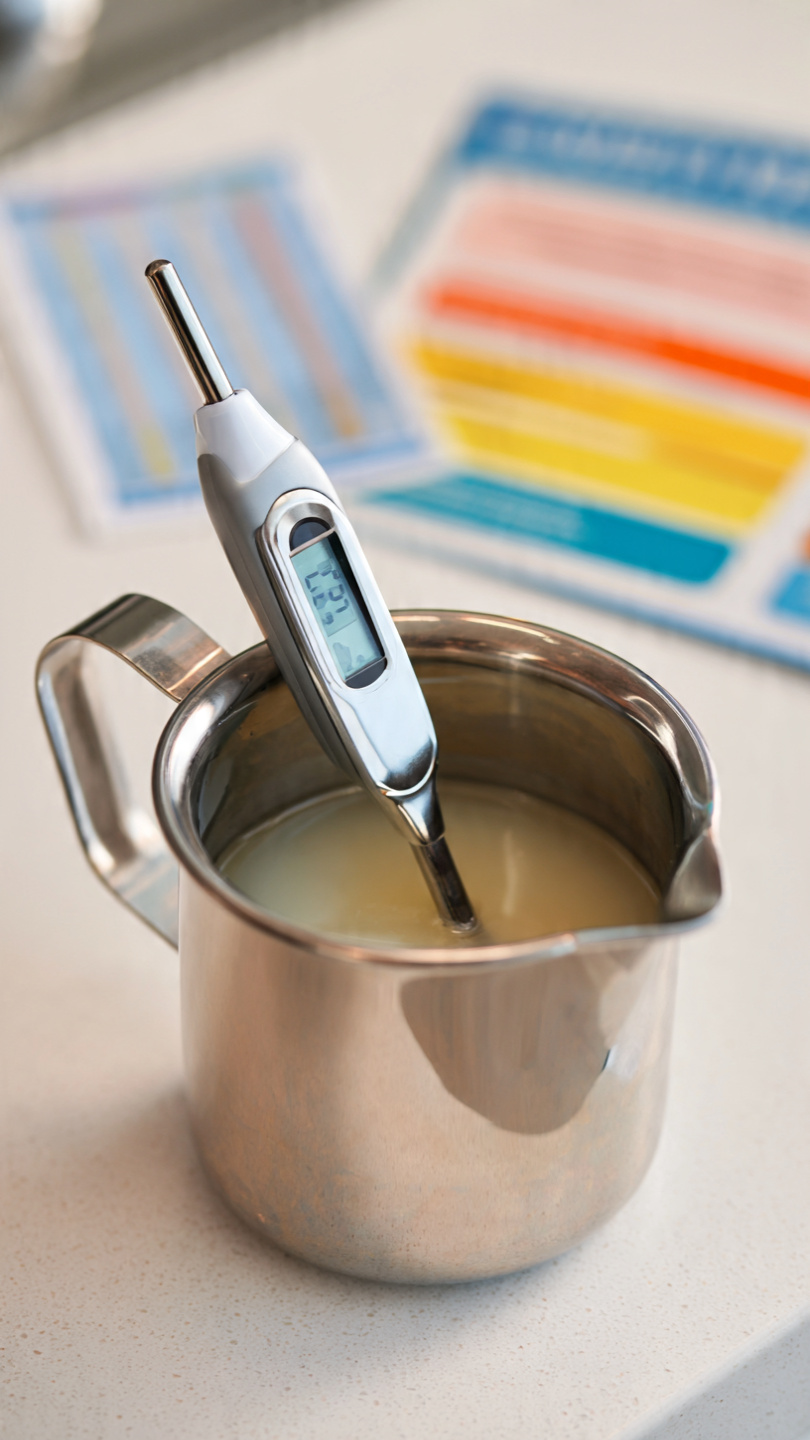
The practical margin between normal working temperatures and flash points looks reassuringly large in the chart above. Soy wax melts at 120°F and flashes at approximately 375°F — a gap of over 250°F. The problem is that without a thermometer, you have no way of knowing where in that gap you are at any given moment. A wax pot left on medium heat for 20 extra minutes can climb 100°F or more. A malfunctioning melting pot thermostat can overshoot its target temperature significantly without any visual change in the wax below the flash point. Never rely on the appearance of the wax to assess its temperature. Use a calibrated digital thermometer with a probe, monitor actively during every melt session, and never leave melting wax unattended.
Additionally, never use an open flame — a gas range burner, a propane torch, a camping stove — as your primary wax melting heat source. Open flame introduces an ignition source into the same space as heated wax and wax vapor. Even if the wax temperature is well below flash point, splatter, vapor pockets, and unexpected temperature spikes make this a combination that professional candle makers categorically avoid.
Fragrance Load and Temperature: Getting the Bond Right
Fragrance oils have their own flash points — typically between 140°F and 200°F for most candle-grade fragrance oils, though this varies significantly by formulation. This is why the temperature at which you add fragrance is not arbitrary: you want to add fragrance oil to wax that is hot enough to allow thorough incorporation, but not so far above the fragrance's own flash point that you are volatilizing aromatic compounds before they can bind to the wax.
The generally recommended window for fragrance addition — 175–185°F for most soy and paraffin applications — is hot enough to keep the wax fully liquid and mobile for thorough mixing, while remaining below the flash point of most fragrance oils. At this temperature, the aromatic molecules integrate into the wax matrix rather than flashing off as vapor. Fragrance added to wax that is too cool will not bind evenly and can cause separation, frosting, or inconsistent scent throw. Fragrance added at excessively high temperatures risks volatilizing the lighter top-note aromatic compounds before they are locked into the wax, producing a candle that smells different — usually flatter and less complex — than it should.
Every fragrance oil has a published flash point on its SDS or product data sheet. Before working with any new fragrance, confirm its flash point and ensure you are adding it to wax that is at or below that temperature. This is particularly important with fragrance oils that contain high concentrations of citrus or top-note compounds, which tend to have lower flash points than base-note heavy formulations.
Frequently Asked Questions
What is the flash point of soy wax?
The flash point of most container soy waxes falls in the range of approximately 375°F to 450°F (191°C to 232°C), depending on the specific formulation and the degree of hydrogenation in the soy oil base. Fully hydrogenated soy wax tends toward the higher end of this range; partially hydrogenated or blended soy waxes may be lower. These figures are general industry approximations — the authoritative flash point for your specific soy wax will be published on its Safety Data Sheet, which your supplier is legally obligated to provide. If you are working with a soy-paraffin blend or a soy-coconut blend, the flash point of the blend may differ from either component in isolation. Always verify against your actual product's SDS rather than relying on category averages, particularly if you are working with high heat or large batch volumes.
Does pouring wax too hot cause sinkholes?
Yes — pouring wax significantly above the recommended pour temperature is one of the two primary causes of sinkholes, the other being rapid or uneven cooling after the pour. When wax is poured very hot, the glass or container walls chill and set the outer wax surface quickly, while the still-liquid interior wax continues cooling and contracting over a longer period. The outer shell locks in place before the interior has finished contracting, and as the interior wax shrinks away from that fixed shell, it creates a void directly beneath the surface — the classic sinkhole. Pouring at the correct temperature for your wax type allows more even, gradual cooling from the surface inward, reducing the temperature differential between inner and outer wax and giving contraction less opportunity to create isolated voids. For most container soy waxes, the target pour temperature of 120°F–140°F exists precisely because this range has been found to minimize both sinkholes and other surface defects like frosting and wet spots simultaneously.
Temperature control in candle making is not a detail — it is the discipline that determines whether every other variable in your process performs as intended. A calibrated thermometer is the most important tool in your studio, and the SDS sheet for every material you work with is the most important document. Together, they give you the complete picture of what your materials can and cannot safely do — which is the only foundation from which reliable, beautiful, and safe candles can be made consistently.