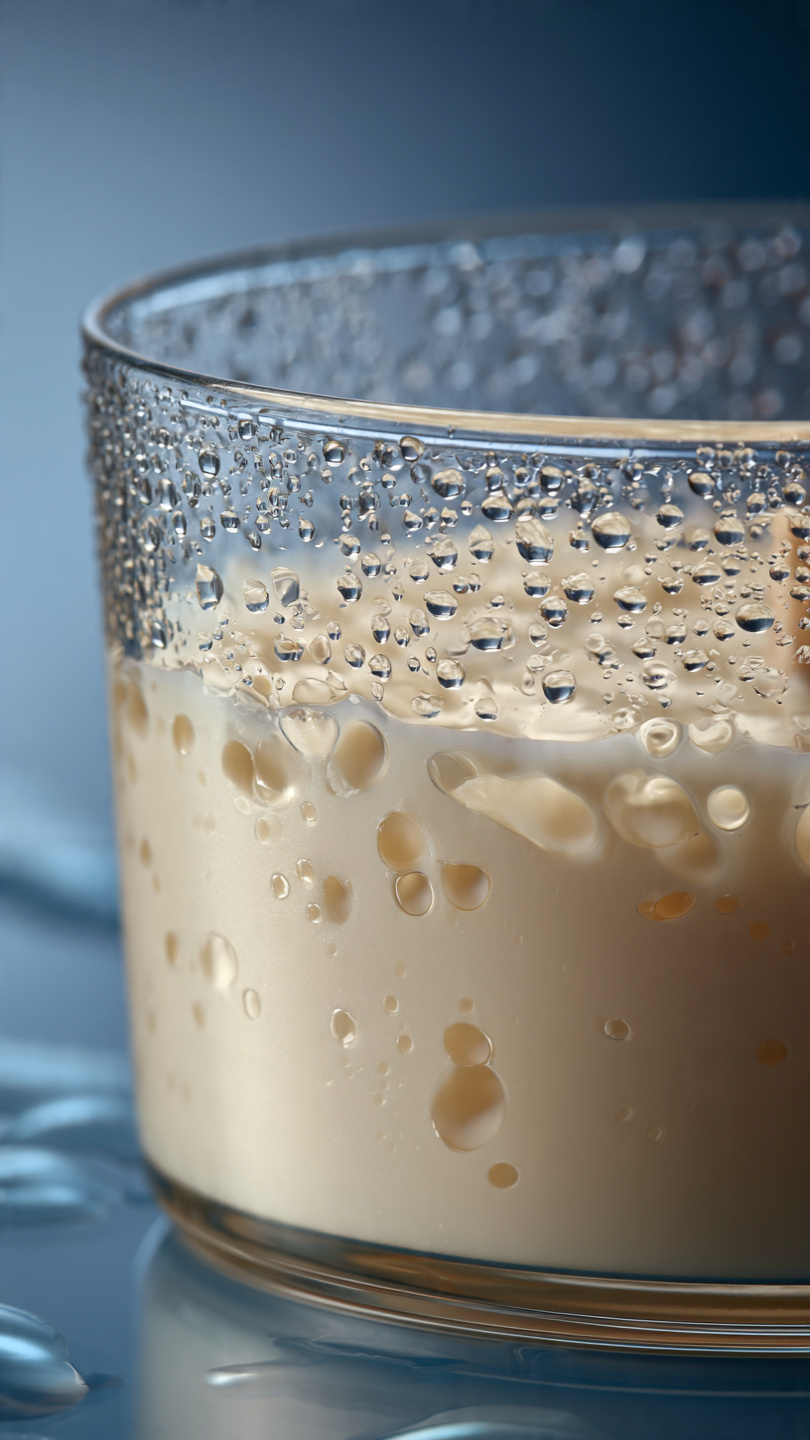
You've just poured a beautiful batch of candles. The fragrance smells perfect, the wax set smooth, and then — looking through the jar — you notice strange cloudy patches pressed against the glass, like someone held a damp hand to the side of the container. No moisture was involved, nothing spilled, and yet the blemishes are unmistakably there.
These are wet spots, one of the most frequently asked-about issues in candle making, and one of the most misunderstood. New makers often assume something went wrong with the wax, the fragrance, or the pour itself. In reality, wet spots are a glass-and-physics problem, not a wax problem — and understanding the difference changes everything about how you approach them.
The Science of Wax Adhesion and Why It Fails
To understand wet spots, you first need to understand what holds wax against glass in the first place. When hot liquid wax is poured into a jar, it makes full contact with the glass walls as it fills the container. As the wax cools and transitions from liquid to solid, it contracts — all waxes do this, but soy wax is particularly prone to contraction due to its softer, more flexible crystalline structure. During this contraction, the wax pulls inward and away from the glass walls in certain areas, breaking the adhesion bond and leaving a thin air gap between the solid wax and the inside surface of the jar.
From outside the jar, that air gap scatters light differently than wax pressed firmly against glass. The result looks like a wet patch, a shadow, or a cloudy fingerprint — hence the name. The spot itself contains no moisture and is not a structural defect in the wax.
Why Temperature Swings Are the Primary Driver
The adhesion bond between wax and glass is most vulnerable during the cooling phase, and the more dramatic or uneven that cooling is, the more likely wet spots become. When a jar is cold and wax is poured in hot, the glass and wax are at extremely different temperatures. The glass chills the wax surface touching it almost immediately, causing that outer layer to begin contracting and setting before the interior wax has even started to cool. This differential — the outside setting faster than the inside — creates internal stresses in the wax that tend to resolve by pulling away from the glass in irregular patches.
Similarly, if a candle is cooling in an environment with temperature fluctuations — near an air conditioning vent, in a space that cools significantly overnight, or close to a drafty window — the wax undergoes repeated micro-cycles of expansion and contraction as ambient temperature shifts. Each cycle can stress the adhesion bond further, producing spots that appear hours or even days after the initial pour as the candle continues to settle.
The Role of Glass Thickness and Shape
Not all jars are equally prone to wet spots. Thicker glass holds cold longer and creates a sharper temperature differential with hot wax. Jars with straight, smooth walls give wax fewer surface irregularities to grip. Textured or slightly irregular glass surfaces — like vintage-style mason jars — actually tend to hold adhesion better because the microscopic surface variation gives the wax more to grip as it contracts. If you're consistently battling wet spots and have tried every prevention technique, experimenting with a different jar profile is a legitimate diagnostic step.
Can You Fix Wet Spots After They Form?
This is where many candle makers spend time and energy that would be better redirected toward prevention. The honest answer is: wet spots, once formed, are almost entirely irreversible. Here's why.
The air gap that creates the wet spot appearance is located between the glass and the solid wax — it's a structural condition of how the wax cooled and set. To eliminate it, you would need to re-melt the wax back to a liquid state, allow it to re-adhere to the glass, and then cool it again under perfectly controlled conditions — with no guarantee the same spot won't reappear. In practice, re-melting a poured candle this way is impractical, often worsens other surface issues, and frequently produces new wet spots in different locations as the wax contracts a second time.
Some makers attempt using a heat gun to warm the outside of the glass jar, hoping to soften the wax just enough to re-press it against the glass. This can temporarily reduce the appearance of a wet spot in certain cases — but the effect rarely lasts through the first burn. Once the candle is lit and the interior wax becomes liquid again, it re-contracts as it re-solidifies after the burn, and the wet spot typically reappears.
The practical takeaway: accept that any wet spots in a cured batch are cosmetic features of that batch, not failures requiring correction. Direct your energy toward the next pour and apply the prevention steps below.
3 Proven Ways to Prevent Wet Spots
Prevention is where meaningful progress happens. These three techniques address the root causes — temperature differential, cooling instability, and pour conditions — directly and measurably.
1. Pre-Heat Your Jars
This is the single highest-impact change you can make. By warming your jars before pouring, you dramatically reduce the temperature gap between the glass and the incoming hot wax, giving the wax a gentler, more uniform environment in which to cool and contract. The target is 10–15°F above room temperature — typically 75–85°F (24–29°C) in a standard workspace.
The easiest method is to place empty jars in a warm oven at the lowest setting (around 170°F) for 5 minutes, then remove them and allow them to cool to the target range before pouring — do not pour into oven-hot jars, as extreme heat creates its own adhesion problems. Alternatively, set jars on a seedling heat mat or warm them with a heat gun on a low setting for 30–40 seconds. Whatever method you use, the goal is a gentle, even warmth — not hot glass, just non-cold glass.
2. Control Your Pour Temperature
Pouring wax at the correct temperature for your specific wax type reduces the thermal shock between wax and glass and slows the early surface-setting that initiates adhesion failure. For most container soy waxes, the target pour range is 120°F–140°F (49°C–60°C). Pouring above this range means the wax hits the glass very hot, cools too quickly at the surface, and contracts sharply. Pouring below it means the wax is already semi-viscous and may trap air against the glass as it finishes setting.
Use a calibrated digital thermometer for every pour — estimating temperature by eye or touch is not precise enough to consistently land in the target window. Small batch-to-batch variations in pour temperature are one of the most common reasons wet spots appear unpredictably even when a maker believes they're following the same process each time.
3. Ensure a Slow, Stable Cool
Once the wax is poured, the cooling environment matters as much as anything that happened before the pour. Place candles to cool in a room-temperature space — ideally 65–75°F (18–24°C) — away from air conditioning vents, fans, open windows, and exterior walls that conduct cold. Do not place candles in a refrigerator or cold room to speed curing; rapid cooling is one of the most reliable ways to guarantee wet spots and other surface defects.
Avoid moving the jars for at least 2 hours after pouring, and ideally leave them undisturbed overnight. Vibration and movement during the setting phase can disrupt the adhesion bond as it forms. If your workspace cools significantly at night — as many do when heating systems cycle down — consider covering your candle batch lightly with a cardboard box or towel to slow the rate of heat loss and buffer them from sudden temperature drops.
Frequently Asked Questions
Are wet spots on candles normal?
Yes — wet spots are one of the most normal and common occurrences in candle making, particularly with soy wax in glass containers. Even highly experienced makers with professional setups encounter them occasionally, because the adhesion between wax and glass is sensitive to variables that are genuinely difficult to control perfectly every time: ambient humidity, slight jar-to-jar glass thickness variation, and minor temperature fluctuations during cooling. Their presence in a batch does not indicate a poorly made candle, substandard wax, or incorrect fragrance loading. Many professional candle brands include a note on their packaging explicitly telling customers that wet spots are a natural characteristic of soy candles and have no effect on performance. If you're making candles to sell, a similar note in your product description sets accurate expectations and eliminates customer confusion before it starts.
Do wet spots affect scent throw?
No — wet spots have no measurable effect on scent throw, either cold (the fragrance you smell from an unlit candle) or hot (the fragrance released while burning). Scent throw is determined by fragrance load percentage, the quality and formulation of the fragrance oil, wick size, and melt pool depth — none of which are related to the glass adhesion behavior that produces wet spots. The air gap between wax and glass is cosmetic and peripheral; it does not alter the chemistry of the fragrance or the way heat is distributed through the wax during a burn. A candle with significant wet spots will perform identically — in terms of scent, burn time, and flame behavior — to an identical candle with a perfectly smooth, adhesion-free pour. The only thing wet spots affect is appearance, which matters for sales presentation but nothing else.
Wet spots are candle making's great equalizer — they humble beginners and experienced makers alike, and they respond not to anxiety but to process. Pre-heat your jars, pour at the right temperature, cool slowly, and you'll minimize them to the point where they become a rare exception rather than a batch-wide expectation.